Shipping from China to USA 2026 Guide: Costs, Time, Methods, Tariffs & Cost-Saving Tips
Quick Answer: Ship from China to US: Ways, Costs, Times & Tips
- Express shipping: $8–$15/kg, 2-5 days.
- Air freight: $5.5–$9.5/kg, 3-7 days.
- LCL ocean freight: $100–$160/CBM, 18-45 days.
- FCL ocean shipping: $4,000–$9,500, 14-40 days.
- Hire a reliable freight forwarder will saving you time and cost.
Last updated: August 2026
Reviewed monthly by CFC logistics specialists
Navigating shipping from China to the USA in 2026 requires more than just comparing freight rates; it demands a clear understanding of evolving tariffs, transit times, and hidden logistics costs. In this comprehensive guide, we break down everything you need to know to optimize your supply chain, including up-to-date cost benchmarks for express, air, and ocean freight, the impact of new Section 301 tariff changes, and actionable strategies to reduce your total landed cost through smarter planning and the right freight forwarding partner.
How to Choose the Right China–US Shipping Method for Your Cargo
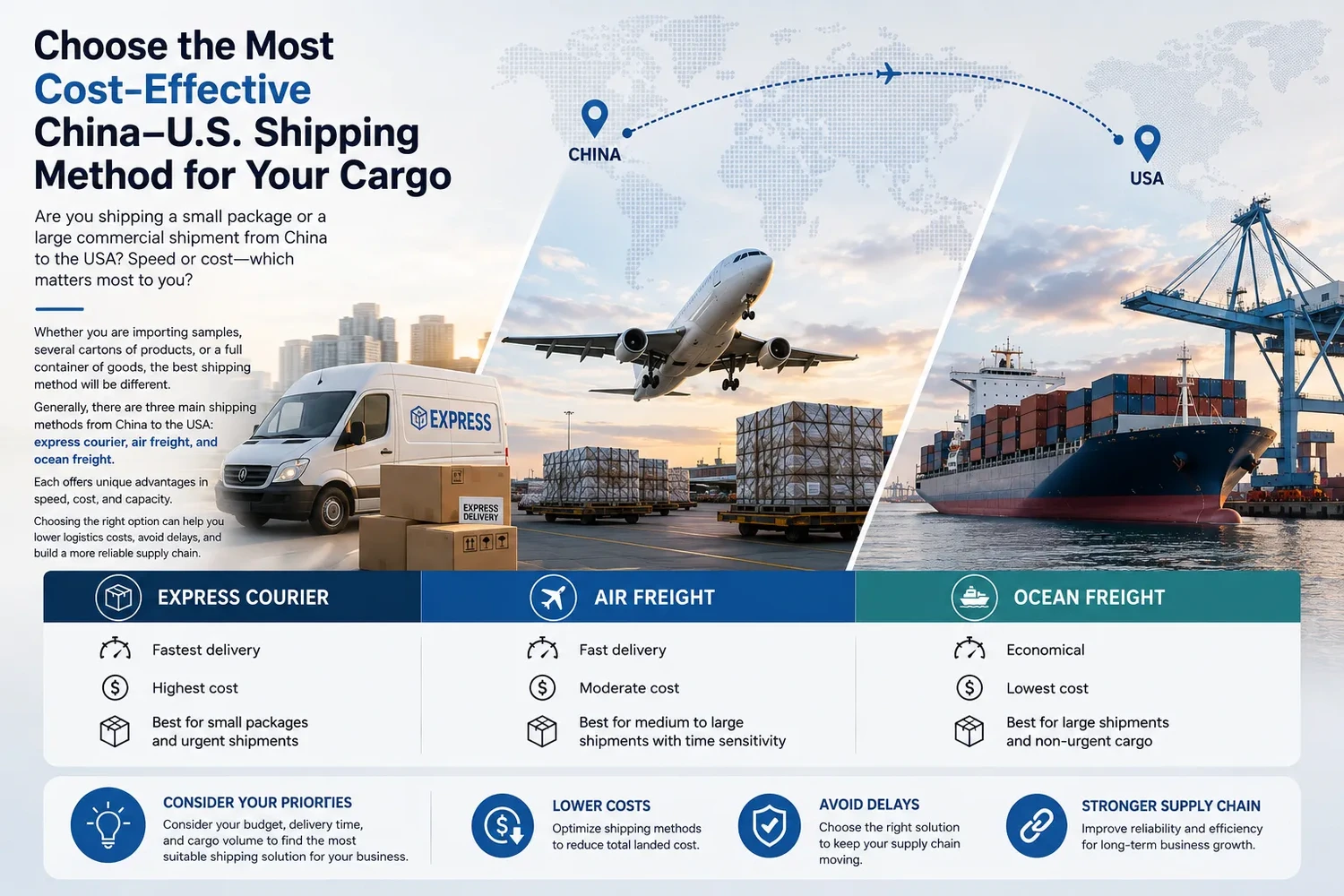
Are you shipping a small package or a large commercial shipment from China to the USA? Whether speed is your priority or you’re focused on minimizing costs, the right choice depends entirely on what you’re moving. From sample parcels to full container loads, each shipment size calls for a different approach. Generally, there are three main options: express shipping, air freight, and ocean freight, each with its own balance of speed, cost, and capacity.
Choosing the right shipping method starts with understanding what each option actually delivers. Below, we break down express courier, air freight, ocean freight(LCL and FCL), so you can match the best solution to your specific cargo size, timeline, and budget.
Express Courier from China to USA
Features: Express courier is the fastest and most convenient shipping option. Major carriers such as DHL, FedEx, and UPS provide door-to-door delivery, customs clearance support, and shipment tracking. It is ideal for samples, documents, emergency inventory restocks, and high-value small parcels under 100kg.
DHL vs. UPS vs. FedEx: Cost and Transit Time
| Carrier | Service Features | Estimated Transit Time (Door-to-Door) | 1-5 kg | 5-20 kg | 20-100 kg |
|---|---|---|---|---|---|
| DHL | Fastest express option; extensive coverage in U.S. residential and business delivery |
2-5 days | $20-35/kg | $12-20/kg | $8-15/kg |
| FedEx | Strong U.S. domestic delivery network; suitable for commercial shipments |
2-6 days | $20-40/kg | $11-18/kg | $7-14/kg |
| UPS | Strong brokerage and commercial customs support |
2-5 days | $20-40/kg | $11-18/kg | $7-14/kg |
Air Freight from China to USA
Features: Air freight is a cost-effective solution for medium-sized, high-value shipments between 100 kg and 500 kg that require fast delivery. Unlike express courier, air freight rates typically cover airport-to-airport transportation only, meaning importers have to arrange or purchase additional services such as customs clearance, terminal handling, and final-mile delivery.
Typical China-U.S. Air Freight Rates and Transit Time in August 2026
The freight rates below are based on market data and should be used as a cost reference rather than a fixed quotation.
| Destination | 100–200 kg | 200–300 kg | 300–500 kg | Transit Time (Airport-to-Airport) |
|---|---|---|---|---|
| U.S. West Coast (Los Angeles, Long Beach, Seattle) | $6.5-8/kg | $5.8-7/kg | $5-6.5/kg | 3-5 days |
| U.S. East Coast (New York, New Jersey, Boston) | $7.5-9.5/kg | $6.5-8/kg | $5.8-7.5/kg | 4-7 days |
| U.S. Midwest (Chicago, Dallas, Atlanta) | $7-9/kg | $6-8/kg | $5.5-7.5/kg | 4-7 days |
Which Chinese Airports Are Best for Shipping to the USA?
The best departure airport depends mainly on where your supplier is located and what type of cargo you are shipping.
| China Export Airport | Code | Main Advantage | Common Cargo |
|---|---|---|---|
| Shanghai Pudong International Airport | PVG | Major international hub connecting Yangtze River Delta exporters | Machinery, medical devices, electronics |
| Shenzhen Bao’an International Airport | SZX | Manufacturing hub for South China exports | Electronics, consumer products |
| Guangzhou Baiyun International Airport | CAN | Major cargo gateway for Pearl River Delta manufacturers | General cargo, textiles, electronics |
| Hong Kong International Airport | HKG | Flexible export gateway for high-value and battery products | Lithium batteries, e-commerce goods |
| Beijing Capital International Airport | PEK | Key North China logistics hub | Technology, pharmaceuticals |
Popular China-US Air Freight Routes and Costs
The freight rates below are based on market data and should be used as a cost reference rather than a fixed quotation.
| Major Route | Region | Estimated Cost | Transit Time |
|---|---|---|---|
| Shenzhen (SZX) → Los Angeles (LAX) | US West Coast | $5-9/kg | 3–5 days |
| Guangzhou (CAN) → Los Angeles (LAX) | US West Coast | $5-8/kg | 3–5 days |
| Shanghai (PVG) → Los Angeles (LAX) | US West Coast | $5.5-8.5/kg | 3–6 days |
| Shenzhen (SZX) → New York (JFK) | US East Coast | $6-9.5/kg | 4–7 days |
| Shanghai (PVG) → Chicago (ORD) | US Midwest | $6–9/kg | 4–7 days |
Ocean Freight from China to USA
Features: Ocean freight offers the lowest transportation cost per unit and the highest cargo capacity. Depending on shipment volume, importers can choose between Full Container Load (FCL) and Less than Container Load (LCL) to achieve the best balance of cost and efficiency.
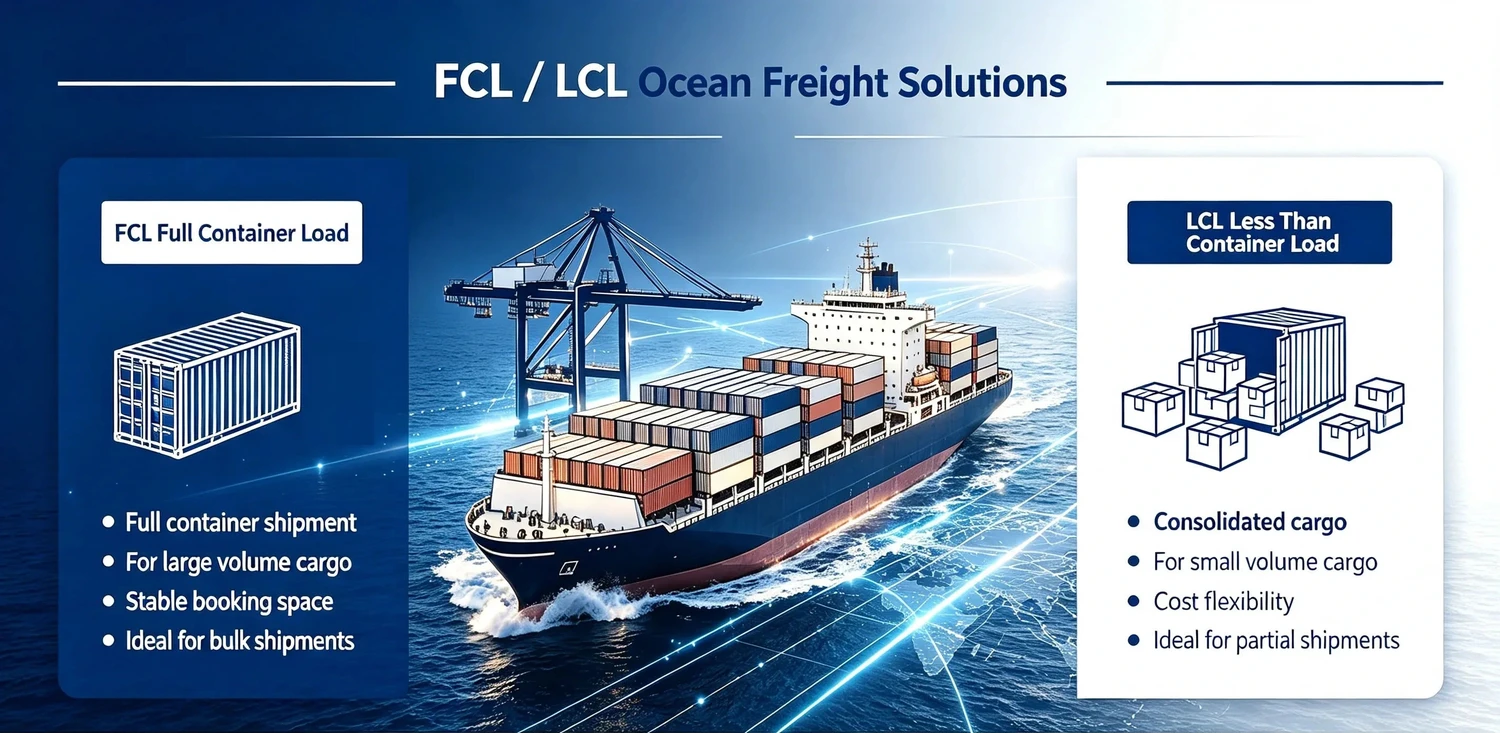
FCL vs. LCL Ocean Freight: Understanding the Key Differences
| FCL | LCL | |
|---|---|---|
| Definition | One shipper books an entire 20ft or 40ft container for exclusive use. | Multiple shippers share space in the same container Pay based on cargo volume/weight (whichever is higher). |
| Best For | Shipments over 15 CBM Bulk cargo |
Shipments under 15 CBM Small-batch goods from multiple suppliers |
| Cargo Handling | Loaded once at origin and unloaded once at destination | Multiple handling stages during consolidation and deconsolidation |
| Risk of Damage | Low because the cargo remains sealed in one container | Higher due to additional consolidation and deconsolidation and shared container space |
| Customs Clearance | Single set of documentation | Separate documentation for multiple shippers Increased administrative workload |
| Delay Risk | Lower—only your cargo affects customs clearance | Higher—issues with another shipper’s cargo can delay the entire container |
| Additional fees | No deconsolidation fee | Additional consolidation, deconsolidation, and handling fees may apply |
| Transit Time | Generally faster because there is no consolidation or deconsolidation | Slightly longer due to cargo consolidation and deconsolidation |
Typical China-U.S. Ocean Freight Rates and Transit Time in August 2026
The freight rates below are based on market data and should be used as a cost reference rather than a fixed quotation.
| Shipping Mode | U.S. West Coast (Los Angeles / Long Beach) | U.S. East Coast (New York / Savannah) | Estimated Transit Time (port to port) |
|---|---|---|---|
| 20GP (FCL) | US$4000–5500 | US$5500–7000 | West: 14–20 days East: 28–40 days |
| 40GP/ 40HQ (FCL) | US$6000–7500 | US$7500–9500 | West: 14–20 days East: 28–40 days |
| LCL | US$100–140 per CBM | US$120–160 per CBM | West: 18–28 days East: 30–45 days |
Note: Ocean freight rate is only one part of your landed cost. Importers should also consider:
- Origin charges in China
- Destination handling charges
- Customs clearance fees
- Duty and tariffs
- Trucking from port to warehouse
Which Chinese Ports Are Best for Ocean Freight to the USA?
The best export port depends mainly on your supplier location and inland transportation costs.
| Major Chinese Port | Port Code | Geographic Advantage |
|---|---|---|
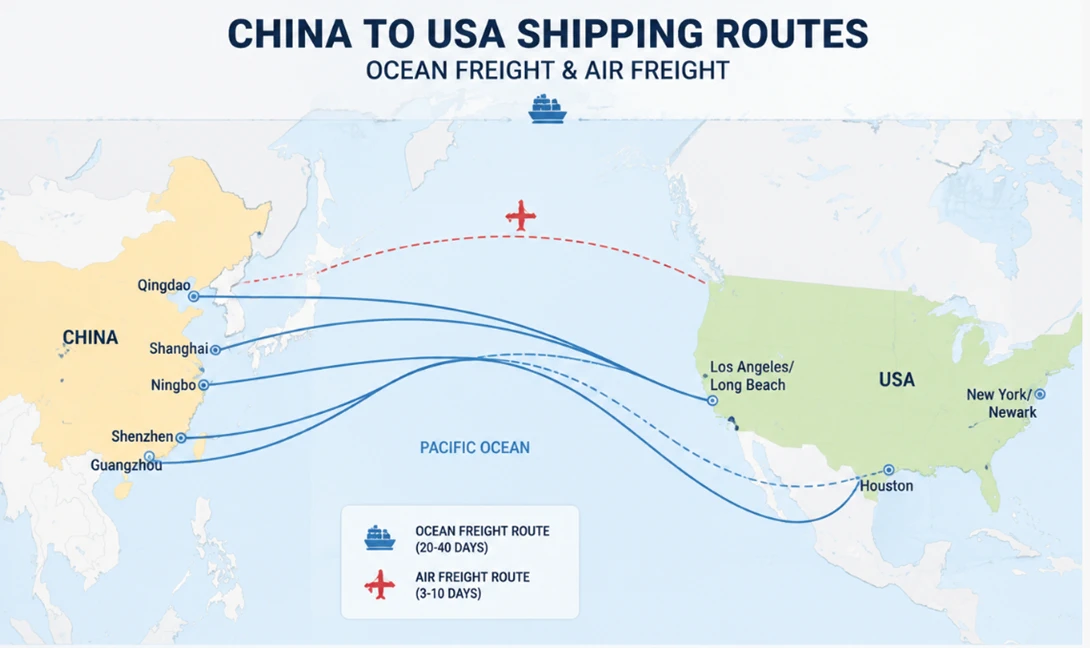
| Shanghai Port | CNSHA | Located in the Yangtze River Delta, China’s largest container port with extensive global routes |
| Shenzhen Port | CNSZX | Located in the Pearl River Delta manufacturing hub, A major gateway for South China exports; one of the most developed logistics hubs for cross-border e-commerce and FBA shipments |
| Guangzhou Port | CNGZH | A key South China export gateway with strong connections to factories in Guangdong |
| Ningbo-Zhoushan Port | CNNGB | Deep-water port with strong trans-Pacific services; ideal for large-volume container exports |
| Qingdao Port | CNTAO | Major northern China gateway serving Shandong and surrounding industrial regions |
| Tianjin Port | CNTXG | Key maritime gateway for Beijing, Tianjin, and northern China |
| Xiamen Port | CNXMN | Important export port for Fujian and southeastern China manufacturers |
Which U.S. Ports Are Best for Imports from China?
The best destination port depends mainly on your inland transportation methods and warehouse accessibility.
| Region | Major Ports | Best For |
|---|---|---|
| West Coast | Los Angeles, Long Beach, Oakland | Fastest China–USA ocean route, ideal for importers prioritizing speed and serving the western U.S. |
| East Coast | New York/New Jersey, Savannah, Charleston | Longer transit, typically via the Panama Canal, but convenient for Northeast and Southeast markets. |
| Gulf Coast | Houston | Longer sailing time, but can reduce inland transportation time for cargo destined for Texas and the central/southern U.S. |
Popular China-U.S. Ocean Freight Routes and Costs
The freight rates below are based on market data and should be used as a cost reference rather than a fixed quotation.
| Route | Estimated FCL Cost | Transit Time (Port-to-Port) |
|---|---|---|
| Shanghai (CNSHA) → Los Angeles (USLAX) | 20GP: $4,765–5,955 40HQ: $6,662–7,100 |
15–25 days |
| Shenzhen (CNSZX) → Long Beach (USLGB) | 20GP: $4,500–5,800 40HQ: $5,575–6,491 |
15–25 days |
| Ningbo-Zhoushan (CNNGB) → Oakland (USOAK) | 20GP: $4,687–5,802 40HQ: $5,700–7,363 |
18–28 days |
| Shanghai (CNSHA) → New York/New Jersey (USNYC) | 20GP: $6,796–7,100 40HQ: $7,575–9,918 |
30–40 days |
| Shenzhen (CNSZX) → Savannah (USSAV) | 20GP: $6,225–7,075 40HQ: $7,404–8,350 |
30–45 days |
Quick Comparison: Express Courier vs. Air Freight vs. Ocean Freight
| Shipping Method | Best For | Shipment Size | Transit Time | Typical Cost | Key Point |
|---|---|---|---|---|---|
| Express Courier | Samples, urgent orders, small high-value parcels | Under 100 kg | 2-5 days | $8-15/kg | Fastest and easiest door-to-door option, but highest cost per kg |
| Air Freight | Time-sensitive commercial shipments | 100-500 kg | 3-7 days | $5.5-9.5/kg | Good balance between speed and cost for medium-sized shipments |
| LCL | Small ocean shipments | Under 15 CBM | 18-45 days | $100-160/CBM | Lower cost for small ocean shipments |
| FCL | Large-volume shipments and regular inventory | 15+ CBM | 14-40 days | $4,000-9,500 | Lowest cost per unit for large shipments |
The Latest U.S. Tariff Changes and Their Impact on Shipping Cost
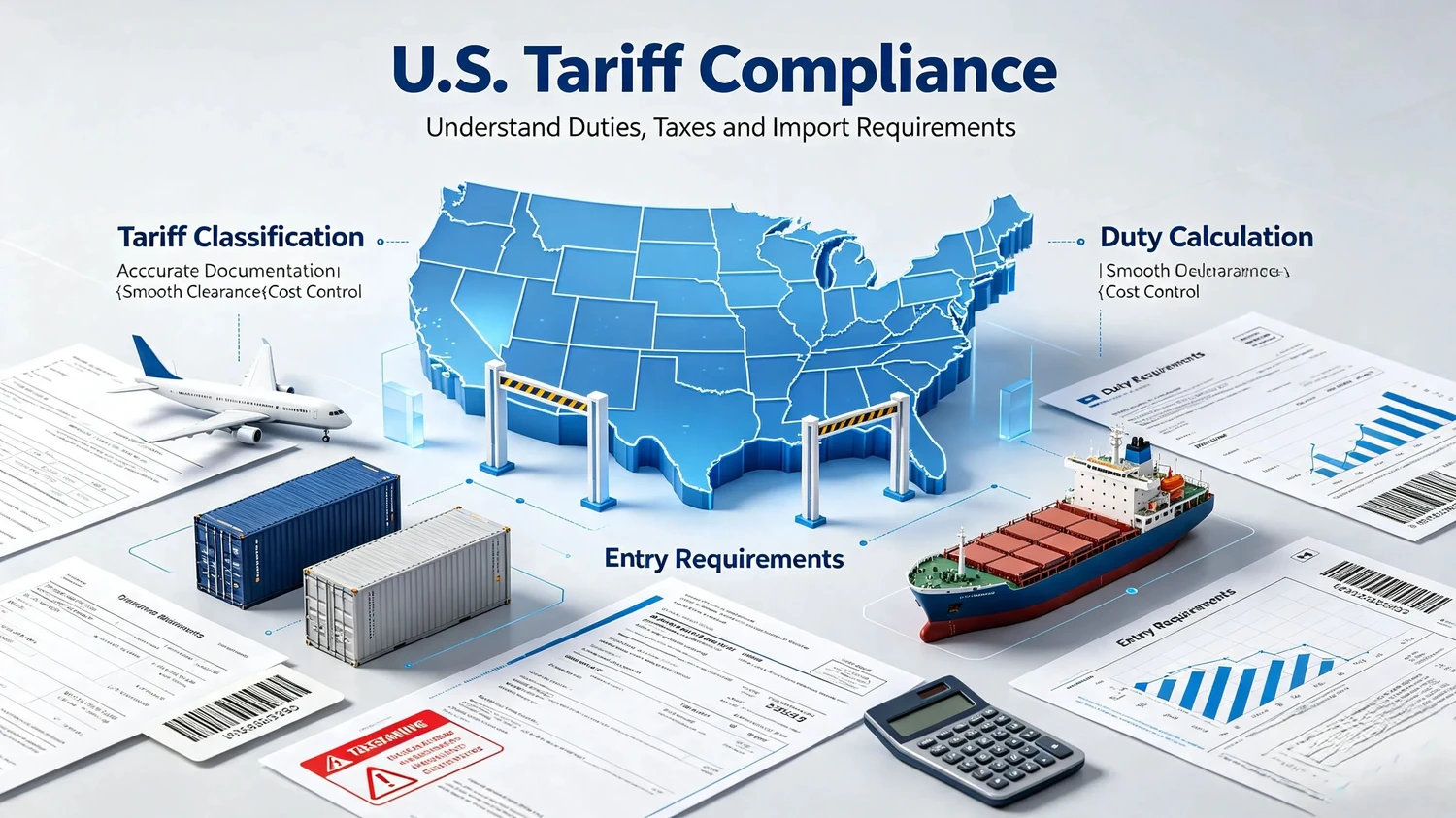
On July 23, 2026, the USTR issued a notice of action concluding 60 parallel Section 301 investigations into the failure of various economies to impose and effectively enforce a prohibition on the importation of goods produced with forced labor. Following this notice, new Section 301 tariffs took effect on July 24, 2026, imposing an additional 12.5% tariff on imports from China and replacing the 10% Section 122 tariff that had expired on the same day. As a result, many Chinese-origin products are now subject to an additional 2.5 percentage points of duty, increasing the overall landed cost of imports. Below are the typical tariff layers for Chinese-origin products:
| Tariff Layer | Typical Rate | Applies To |
|---|---|---|
| Base MFN Duty | Varies | Depends on the HTS classification |
| Section 301 Tariff (Lists 1–4) | 7.5%–100% | Applicable Chinese-origin products |
| Section 301 Forced-Labor Tariff | 12.5% | Applicable products from July 24, 2026 |
| Section 232 Tariff | 25%–50% | Steel, aluminum, automobiles, certain copper, timber, semiconductors, etc. (Note: goods subject to Section 232 are exempted from the new Section 301 forced-labor tariff) |
| AD/CVD | Varies | Products covered by anti-dumping or countervailing duty |
| CBP Processing Fees | MPF & HMF (Ocean freight only) | Applicable to most imports |
Step-by-Step Tariff Calculation
Here is the step-by-step method of calculating the total import duty from China to USA both before July 24, 2026 and after July 24, 2026:
(Using wireless earphone with customs value of US$100,000 as an example)
| Identify the customs value: US$100,000 |
|---|
| Check the 10-digit HTS code and its corresponding base MFN rate: HTSUS: 8518.30.20; Base MFN rate: 0%; Amount: $0 |
| Determine which Section 301 list your product falls under and the applicable rate Applicable section 301 list: List 4A; Applicale rate: 7.5%; Amount: 100,000×7.5%=$7,500 |
| Before July 24 2026 Add the 10% Section 122 surcharge Amount: 100,000×10%=$10,000 |
| Add the Merchandise Processing Fee (MPF): 0.3464% Amount: 100,000×0.3464%=$346.40 |
| Add the Harbor Maintenance Fee (HMF): 0.125% Amount: 100,000×0.125%=$125.00 |
| Total Duties before July 24 2026: 0+7,500+10,000+346.4+125=$17,971.40 |
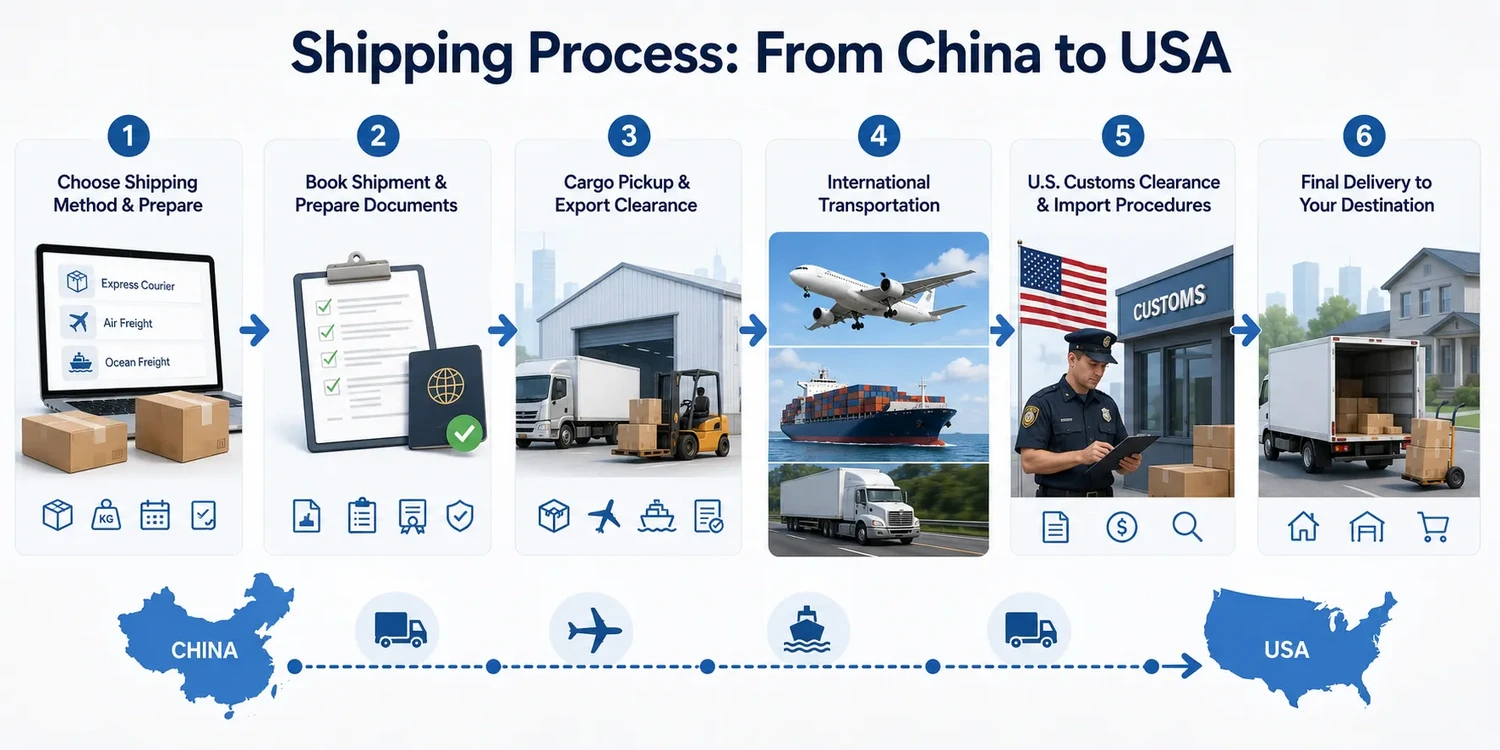
Shipping Process from China to USA

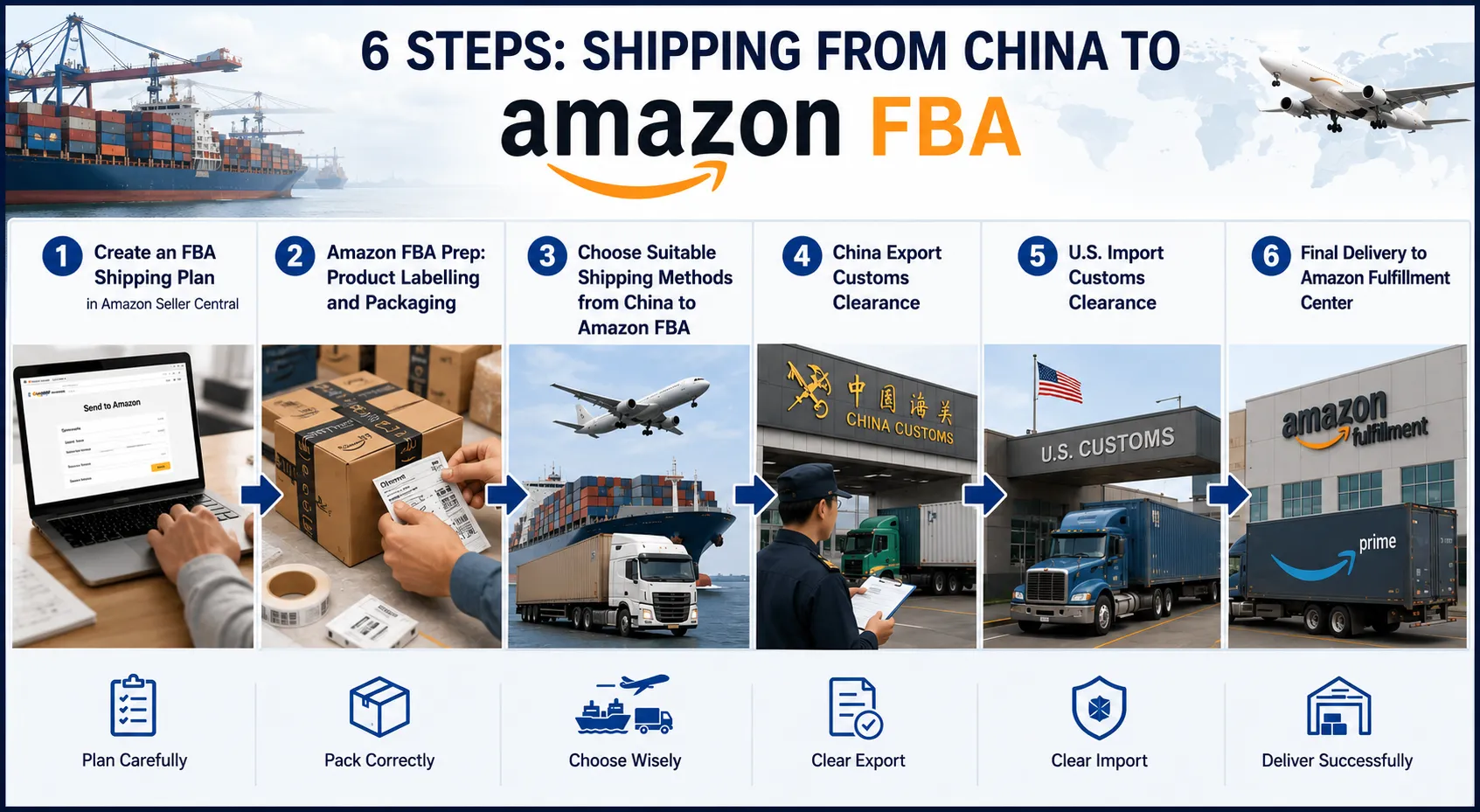
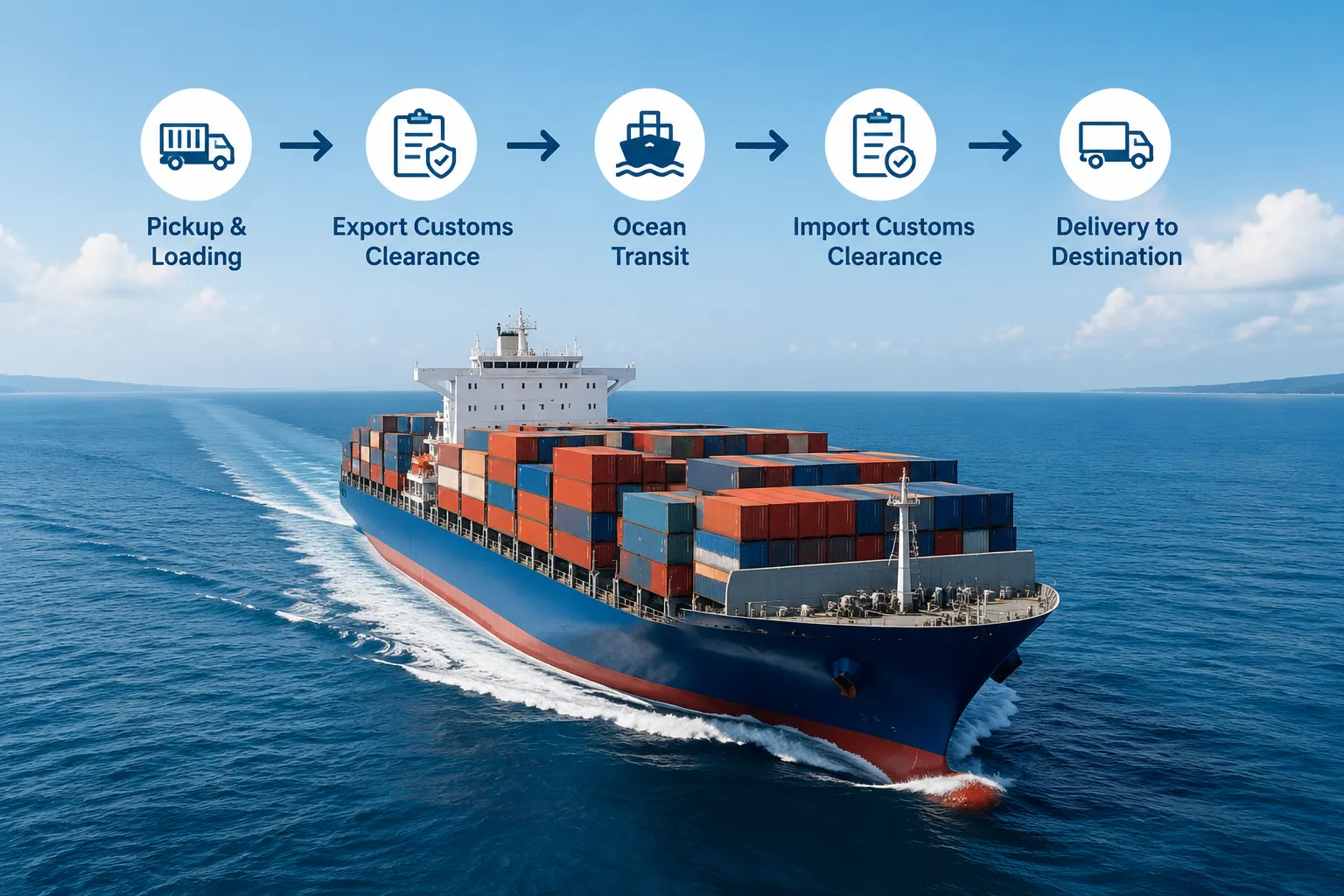
Step 1: Choose the Right Shipping Method and Prepare Your Shipment
The first step is to determine the most suitable shipping method based on confirming the following:
- Product details and HS code
- Shipment weight and dimensions
- Required delivery date
- Shipping terms (Incoterms)
- Required import documents
Express courier is best for small, urgent shipments that require fast door-to-door delivery.
Air freight is suitable for medium-sized, high-value shipments that need faster transit than ocean shipping.
Ocean freight is the most cost-effective option for large-volume shipments, including LCL and FCL cargo.
Step 2: Book Shipment and Prepare Export Documents
After selecting the shipping method, the importer or supplier arranges transportation through a carrier or freight forwarder.
The required documents usually include:
- Commercial invoice
- Packing list
- Bill of lading (ocean freight) or air waybill (air freight)
- Certificate of origin (when required)
- Other product-specific certificates (FCC certification for electronics, CPSC compliance for consumer products, and FDA approval for food or medical devices)
- ISF (Importer Security Filing): Required for ocean freight shipments and must be submitted at least 24 hours before your ocean cargo is loaded onto a vessel, Late or inaccurate ISF filings may result in penalties of $5,000 )
For ocean and air freight, booking in advance is especially important during peak seasons when vessel or aircraft capacity may be limited.
Step 3: Cargo Pickup and Export Clearance in China
Once the shipment is booked, the goods are collected from the supplier’s factory or warehouse.
The cargo is then transported to:
- Courier facility for express shipments
- Airport warehouse for air freight
- Port terminal for ocean freight
Before leaving China, the shipment must complete export customs clearance. The exporter or freight forwarder submits the required documents and ensures the goods comply with export regulations.
Step 4: International Transportation from China to the USA
After export clearance, the goods begin international transportation.
The process depends on the shipping method:
Express Courier
The carrier manages the entire transportation process, including pickup, customs clearance support, and final delivery.
Air Freight
Cargo is transported from a Chinese airport to a U.S. airport.
Importers usually need a customs broker or freight forwarder to arrange customs clearance and local delivery.
Ocean Freight
Cargo is shipped in containers from Chinese ports to U.S. ports.
Importers must arrange customs clearance, port handling, and inland transportation.
Step 5: U.S. Customs Clearance and Import Procedures
When goods arrive in the USA, they must clear U.S. Customs before entering the market.
The importer or customs broker is responsible for:
- Filing import entry documents
- Calculating duties and taxes
- Providing additional documents if requested
Shipments may also be subject to inspection by U.S. authorities before release.
Step 6: Final Delivery to Your Destination
After customs clearance, the shipment moves to its final destination.
The last step depends on the transportation method:
Express courier: Delivered directly to the recipient’s address.
Air freight: Picked up from the airport or delivered through a local trucking service.
Ocean freight: Transported from the port to a warehouse, distribution center, Amazon FBA facility, or final customer.
Strategies to Reduce Shipping Costs from China to USA
As freight rates fluctuate and tariff burdens continue to grow, the total landed cost of importing from China to the USA has risen significantly and has become a major drain on profitability. For high-volume importers, optimizing shipping costs is a strategic priority that can improve cash flow, increase profit margins, and strengthen long-term competitiveness.
Below are practical strategies to help you minimize unnecessary shipping expenses and improve supply chain efficiency.
Reduce Chargeable Weight Through Packaging Optimization
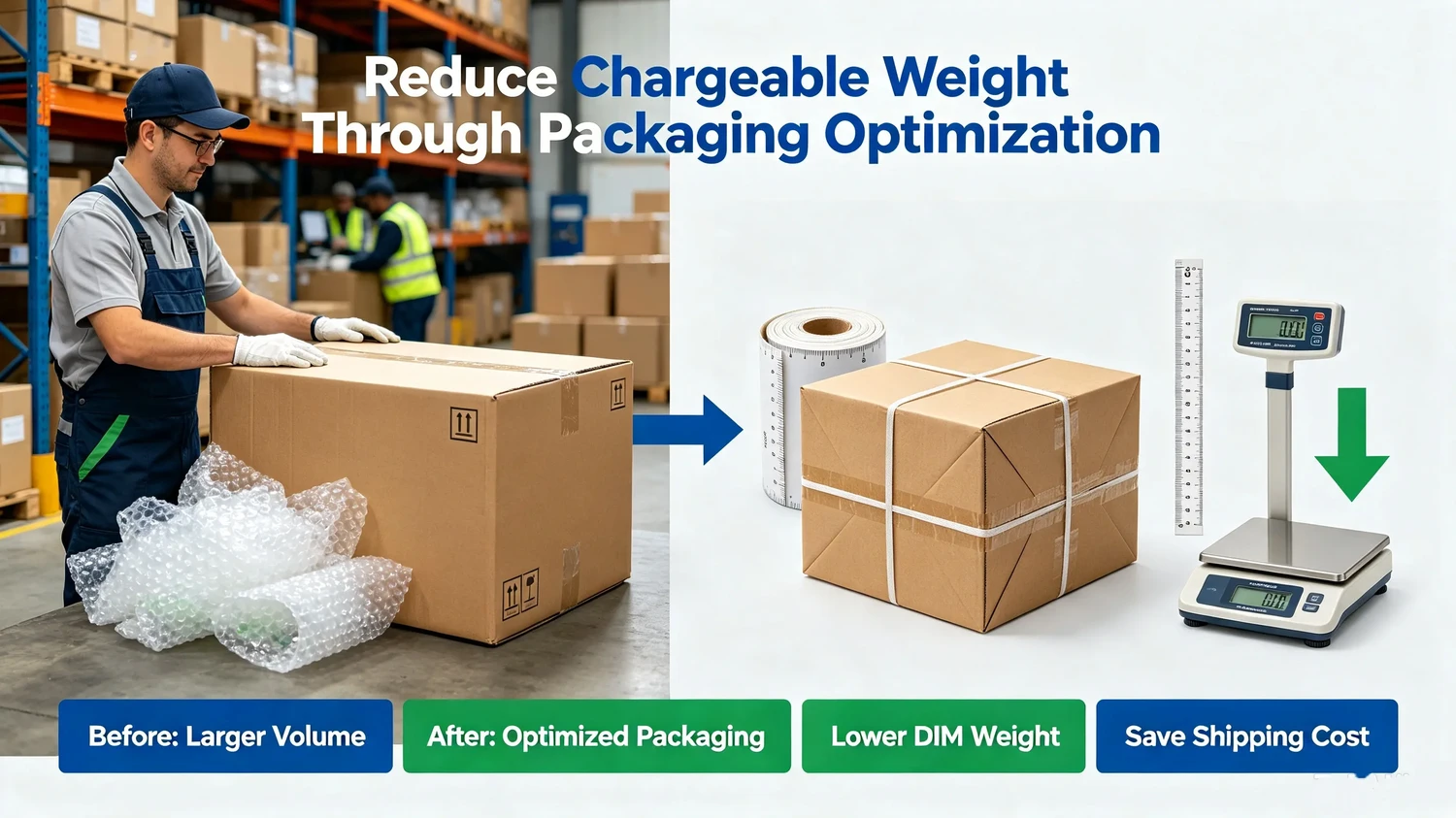
Problem:
You may be paying for empty space instead of actual products. Express and air freight providers charge based on the higher of actual weight or volumetric weight. Oversized cartons, excessive padding, and inefficient packaging can significantly increase your shipping cost.
What to do:
- Use cartons that closely match product dimensions
- Reduce unnecessary packaging materials
- Replace heavy materials with lightweight alternatives
- Increase units per carton where product protection allows
You can use this tool to calculate the chargeable weight.
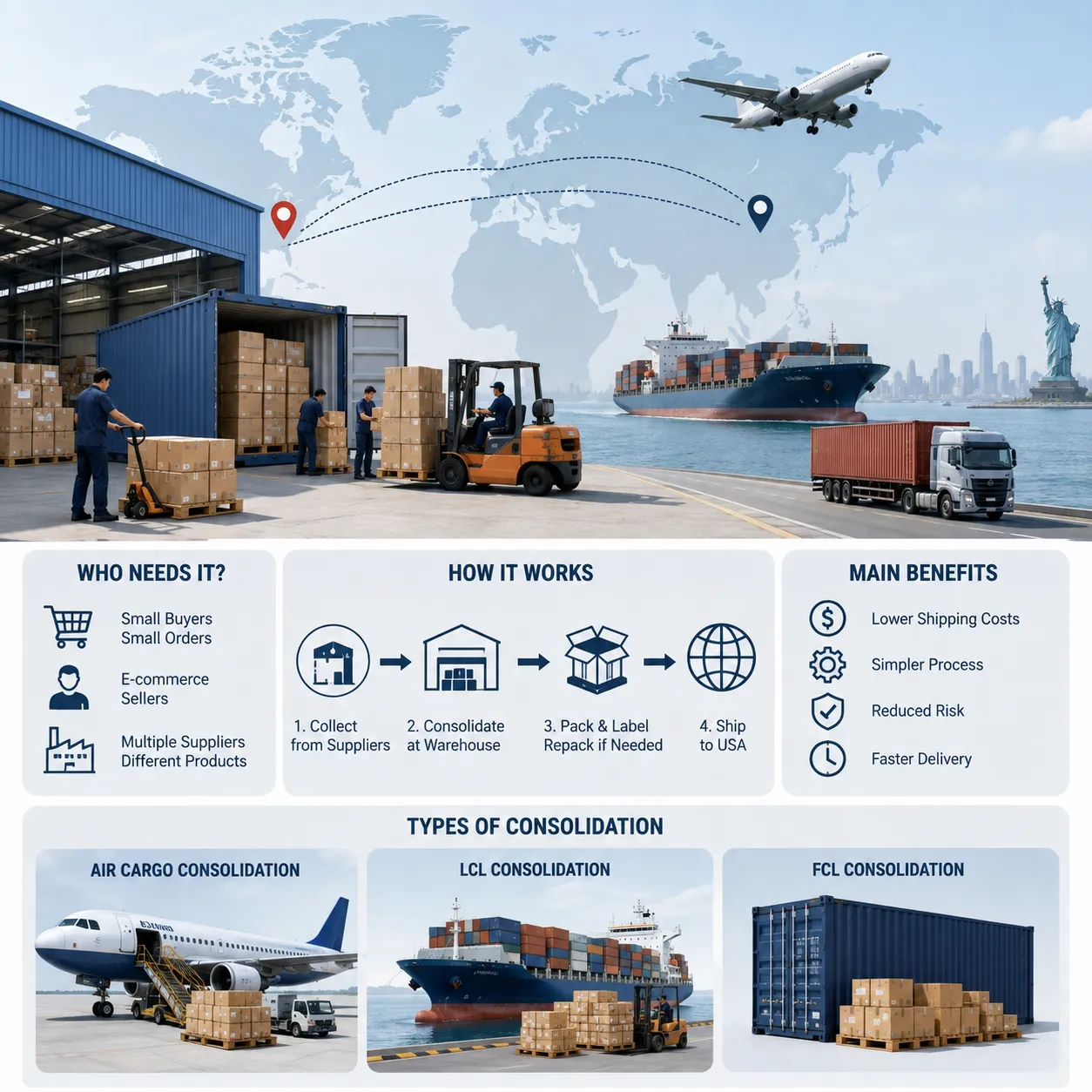
Goods consolidation for one larger shipment:
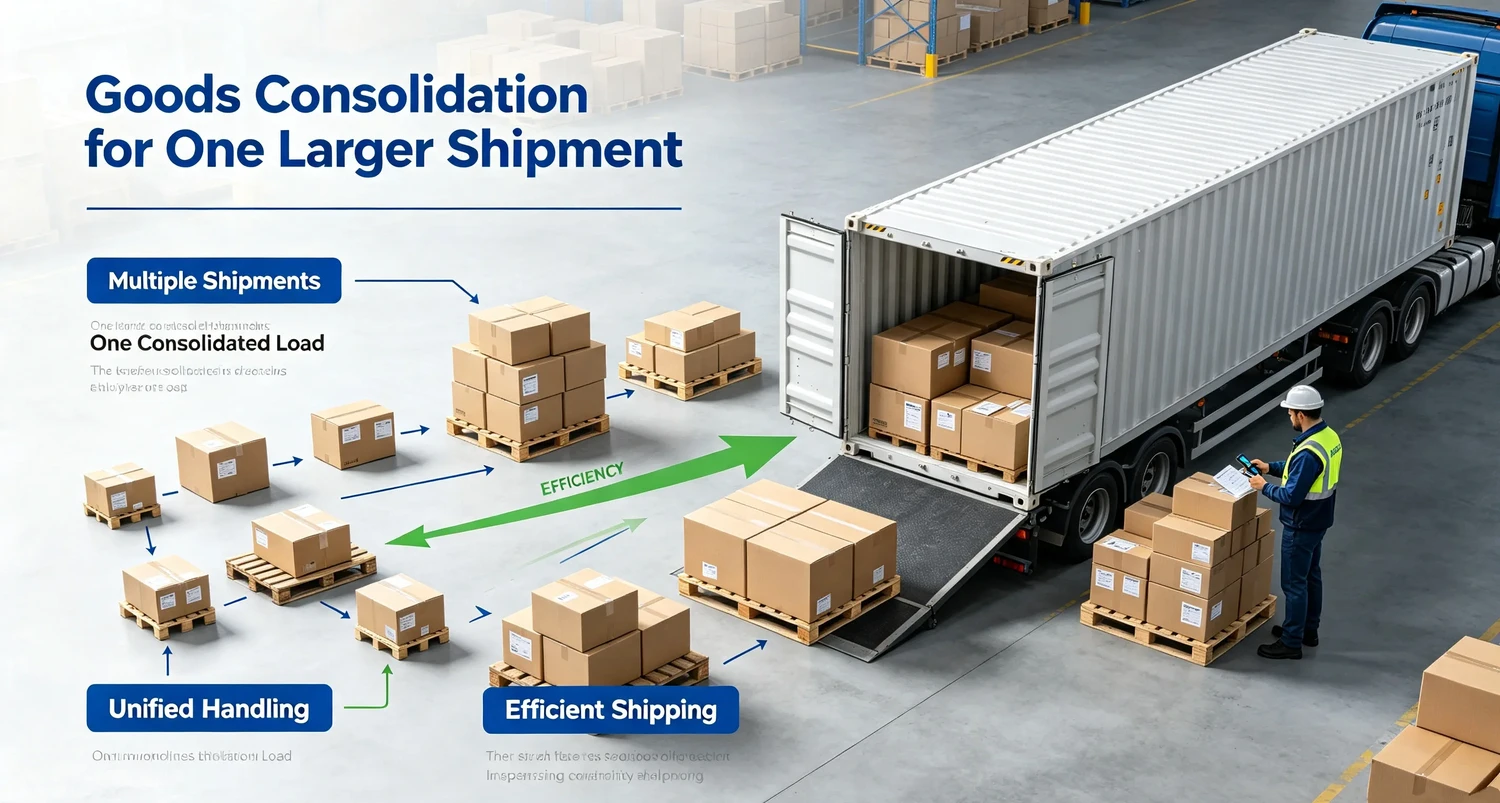
Problem:
Shipping multiple small orders separately creates unnecessary costs.
When purchasing from different suppliers in China, individual shipments often lead to repeated:
- Freight charges
- Handling fees
- Export documentation costs
- Customs processing fees
Better approach:
Combine shipments from multiple suppliers into one larger shipment before export.
Benefits:
- Lower freight cost per unit
- Fewer handling charges
- Easier customs management
- Better inventory planning
For example, instead of shipping three separate 5 CBM LCL shipments, consolidating them into one 15 CBM shipment may allow you to negotiate better ocean freight rates or switch to FCL.
Early Space Booking
Problem:
Waiting until the last minute can turn a predictable shipping cost into an expensive emergency.
During peak periods, container capacity becomes limited, and late bookings may result in:
- Higher spot freight rates
- Peak-season surcharges
- Limited sailing options
- Shipment rollovers
- Demurrage and detention fees
Recommended booking timeline for peak season:
| Period | Recommended Booking Time |
|---|---|
| Regular peak season (August-October) | 60–90 days in advance |
| Q4 holiday rush (October through December) | 90+ days in advance |
Best-suited incoterms determination
The four most commonly used incoterms for shipping from China to the US are EXW, FOB, CIF, and DDP. Each allocates transportation costs, risks, and responsibilities differently between the buyer and the seller.
Choosing the wrong Incoterm can lead to unnecessary costs, limited visibility, or unexpected delays.
| Recommended Incoterm | Export Clearance (China) | Main Freight Cost | Import Clearance & Duties (USA) | Best For Importers When… |
|---|---|---|---|---|
| EXW (Ex Works) | Buyer | Buyer | Buyer | You have experienced freight forwarders and strong China-side logistics support. You want the lowest supplier price and maximum control over freight negotiation |
| FOB (Free On Board) | Seller | Buyer | Buyer | You want the best balance between cost efficiency, shipment control, and operational simplicity. The supplier manages export procedures while you choose your own forwarder and control international freight. |
| CIF (Cost, Insurance and Freight) | Seller | Seller | Buyer | You prefer the supplier to arrange ocean freight and insurance, but you should carefully check destination charges and import costs because freight visibility is limited. |
| DDP (Delivered Duty Paid) | Seller | Seller | Seller | You want a fully managed door-to-door solution. The convenience comes with higher costs. |
Work with an Experienced China–U.S. Freight Forwarder
A freight forwarder is a logistics partner that manages and coordinates the transportation process on behalf of an exporter or an importer. Instead of dealing separately with shipping lines, airlines, customs brokers, and trucking companies, businesses can rely on freight forwarder to arrange shipments, optimize routes, handle documentation, and solve logistics issues.
Freight Forwarders Can Access More Competitive Freight Rates Through Carrier Networks
Many small and medium-sized importers contact carriers directly and are surprised when the quoted rate is much higher than expected. During peak seasons, limited capacity and fluctuating market rates can make it even harder for individual shippers to negotiate.
How ContainerFromChina helps:
By handling substantial China-USA shipping volumes and maintaining established relationships with transportation partners, ContainerFromChina can negotiate competitive rates across:
- Ocean carriers
- Airlines
- Trucking companies
More importantly, we don’t rely on a single carrier or a single solution. We compare rates, available capacity, routes, and service reliability to identify an option that fits your shipment.
Freight forwarders Can Optimize Shipping Methods to Reduce Total Landed Cost
An importer might choose LCL because the cargo doesn’t fill a container, only to discover that multiple handling charges, palletization fees, and origin/terminal costs make the final landed cost surprisingly high. The common mistake? Assuming the cheapest freight rate equals the cheapest total cost.
How ContainerFromChina helps:
We evaluate your:
- Cargo volume and weight
- Product type and fragility
- Delivery timelines and inventory carrying costs
- Warehouse capacity and stock-turn requirements
- Your overall budget
Then we recommend the most appropriate solution, such as:
- Switching from LCL to FCL when the volume threshold makes a full container more economical (often saving 20–30% after accounting for handling fees)
- Consolidating cargo from multiple Chinese suppliers into a single full container to slash per-unit shipping costs and reduce origin handling
- Designing multi-modal solutions (e.g., sea-air or rail-truck) that balance speed and cost more effectively than a single mode. We don’t just book what you ask for, we challenge assumptions and redesign the supply chain to lower your true landed cost.
Freight Forwarders Can Improve Supply Chain Reliability and Reduce Delay Risks
Importers managing shipments independently may book a vessel weeks in advance and assume everything is under control. But vessel rollovers, port congestion, trucking shortages, and peak-season capacity constraints can quickly change the plan.
A few days of delay can lead to storage fees, demurrage and detention, inventory shortages, or missed customer deliveries.
How ContainerFromChina helps:
We don’t wait for problems to happen, we engineer contingencies before they arise. ContainerFromChina can provide alternative solutions by:
- Multi-carrier contingency planning: We don’t rely on a single ocean or air carrier. If your primary vessel is overbooked or rolled, we have pre-vetted alternatives ready to pivot.
- Route intelligence: We actively monitor port congestion, weather patterns, and labor conditions to select less congested ports or alternate routing options that keep your cargo moving.
- Backup transportation options: When a delay is imminent, we can arrange expedited rail or air options to bridge the gap and protect your delivery deadlines.
- Coordinated warehouse and trucking synchronization: We align drayage and warehouse appointments in advance, so your cargo doesn’t sit idle upon arrival.
This isn’t reactive customer service, it’s built-in supply chain resilience that helps importers avoid costly delays, storage fees, and inventory shortages.
Freight Forwarders Can Improve Customs Compliance and Avoid Unexpected Costs
Sometimes, the cargo isn’t the problem—the paperwork is.
An importer can successfully arrange transportation and still face a costly delay because a commercial invoice is inaccurate, a packing list is incomplete, or required documentation is missing. By the time the problem is discovered at the U.S. port, the importer may already be facing customs delays, inspections, storage charges, or shipment release problems.
How ContainerFromChina helps:
We treat customs compliance as a pre-departure prevention process, not a post-departure checklist. Our experienced logistics team understands the specific documentation requirements for different product categories (from electronics to textiles to machinery) and works directly with your suppliers in China to:
- Review and validate commercial invoices, packing lists, bills of lading, and certificates of origin before the cargo leaves the factory
- Flag inconsistencies between documents early—such as mismatched weights, incorrect HS codes, or missing supplier signatures—while they can still be corrected locally
- Coordinate with our customs clearance partners in the U.S. to pre-clear documentation in the system, reducing the chance of random examinations or holds
This early warning system means by the time your container arrives at the U.S. port, the paperwork is already accurate, complete, and aligned, which dramatically reduces the risk of delays, inspections, and unexpected storage fees.
Freight forwarders’ quotation comparison
Comparing quotations from multiple freight forwarders is an effective way to avoid unexpected shipping costs. However, don’t compare freight rates alone. Request detailed, itemized quotations and verify exactly what is included in each offer. A seemingly lower freight rate may exclude destination handling charges, customs clearance, documentation fees, inland delivery, or peak season surcharges, resulting in a higher total landed cost. By comparing both pricing and service scope, you can identify the most cost-effective quotation offered by different freight forwarders and minimize the risk of unexpected charges.
Frequently Asked Questions
Shipping cost from China to US?
As a general reference in August 2026:
- Express: US$8–15/kg
- Air freight: US$5.5–9.5/kg
- Ocean freight LCL to the West Coast: US$100–140/CBM
- Ocean freight LCL to the East Coast: US$120–160/CBM
- Ocean freight FCL 20GP to the West Coast: US$4,000–5,500
- Ocean freight FCL 20GP to the East Coast: US$6,000–7,500
- Ocean freight FCL 40GP/40HQ to the West Coast: US$5,500–7,000
- Ocean freight FCL 40GP/40HQ to the East Coast: US$7,500–9,500
Please treat these figures as indicative market averages only, as actual rates are highly volatile and subject to daily fluctuations in vessel space, equipment availability, and carrier pricing; always request a firm, up-to-date quotation from your freight forwarder before finalizing any booking.
How to ship from China to the US?
To ship from China to the USA, importers usually follow these steps: choose a suitable shipping method (express courier, air freight, or ocean freight), prepare export documents, arrange customs clearance, and deliver the goods to the final destination.
Working with an experienced freight forwarder can simplify the process by helping with transportation, customs documentation, duty calculation, and final delivery arrangements.
Air freight vs. Ocean freight: Which is better?
Choosing between air freight and ocean freight to the USA depends on your cargo’s value, nature, weight, dimensions, and urgency.
Air freight is generally the better choice for high-value, time-sensitive, or relatively lightweight shipments, especially those in the 45-500 kg range where speed is more important than the lowest shipping cost. Air freight typically takes 3-7 days airport-to-airport while express courier can deliver in 2-5 days door-to-door.
For large-volume or heavy cargo with less urgent delivery requirements, ocean freight is usually more cost-effective.However, check cargo restrictions before choosing air freight, as certain dangerous goods—including lithium batteries, flammable liquids, compressed gases, and other hazardous materials—may be restricted or require special packaging, documentation, and carrier approval for air transportation.
FCL vs. LCL: Which should I choose for my goods imported from China?
Choose FCL when your cargo volume exceeds approximately 15 CBM (or when the cost of booking an entire container is lower than the total cost of LCL). Choose LCL for smaller shipments that do not justify a full container.
However, during peak seasons, for shipments close to the FCL/LCL threshold (for example, around 12–15 CBM), importers should consider the additional time required for LCL consolidation, deconsolidation, and cargo handling. If delays could affect inventory availability and seasonal sales, choosing FCL may provide better overall value despite the higher upfront cost.
Moreover, be careful: in the U.S., LCL shipments often come with high destination charges, such as CFS (Container Freight Station) fees and handling costs. When your cargo volume reaches around 12–15 CBM, compare the total cost of LCL shipping versus a 20-foot container (FCL). In some cases, booking a full container can be cheaper overall.
How much are U.S. import duties and tariffs?
After July 24, 2026, for products subject to both Section 301 (Lists 1–4) and the Section 301 Forced-Labor Tariff, the total tariff and duties = Base MFN Duty + Section 301 Tariff (Lists 1–4) (7.5%–100%) + Section 301 Forced-Labor Tariff (12.5%) + MPF & HMF.
Nearly half of all products imported from China fall into this category.
For products subject to Section 232 tariff, the total tariff and duties = Base MFN Duty + Section 232 Tariff (25%–50%) + MPF & HMF.
If a product is also subject to Anti-Dumping Duties (AD) or Countervailing Duties (CVD),these duties should also be added on top of the above duties. Since U.S. tariff policies are frequently changing, please always verify the latest tariff requirements with your customs broker.
How to reduce shipping costs from China?
There are many ways to reduce shipping costs, such as lowering chargeable weight through packaging optimization, consolidating multiple shipments, and booking early to avoid peak-season surcharges and capacity constraints.
However, the most effective strategy is partnering with a reliable freight forwarder with strong carrier relationships, an extensive logistics network, and deep knowledge of shipping documentation and customs procedures. By leveraging their large shipping volumes and long-term partnerships with carriers, freight forwarders can negotiate more competitive rates. More importantly, they can provide proactive solutions to handle unexpected issues, optimize origin and destination operations, and ensure smooth final delivery—helping importers reduce both direct shipping costs and hidden logistics expenses.
How far in advance should I book for China-US peak season shipping?
For the regular peak period from August to October, it is recommended to book containers 60–90 days ahead; during the Q4 holiday rush, especially October through December, importers should reserve space at least 90 days in advance.
FOB vs. DDP shipping from China to USA: Which is better?
For most experienced importers and businesses shipping regularly from China to the USA, FOB is usually the more cost-effective choice because it provides greater control over freight costs, carrier selection, and shipping strategies. DDP is better suited for first-time importers, small businesses, or occasional shipments where convenience and reduced administrative work are more important than achieving the lowest possible logistics cost.